

Does Tuya Send Your Data to China? What Actually Happens
Search “is Tuya safe” and you’ll find the same claim on a dozen sites. Tuya sends your data to China. It shows up as a one-line caveat in device reviews, a forum comment nobody follows up on, or an old news story treated as if it’s still current. None of them explain what that actually means for the smart plug or sensor sitting on your network right now.
I went back to the source of the claim and then cross-referenced it against Tuya’s own current documentation, including the Chinese-language version of its trust center, which turns out to be more detailed than the English mirror most Western readers would find. The short answer is that the claim is outdated as a blanket statement, but the honest answer is more specific than that, and worth walking through properly.
Where the claim comes from
The “Tuya sends data to China” line traces back to a March 2021 report from security firm Dark Cubed, which found Tuya-powered devices making connections to China-based infrastructure and flagged weak security practices in several Android companion apps it reviewed. That report is the origin point. Consumer sites have repeated a compressed version of it ever since without checking whether Tuya’s architecture has changed in the years since.
It’s also worth separating the security-practice findings (app-level issues Dark Cubed identified in 2021) from the data-location question, which is architectural and has moved on considerably. Conflating the two is part of why the claim has stuck around in such a vague form.
What’s actually true today: regional data centers, not one China server
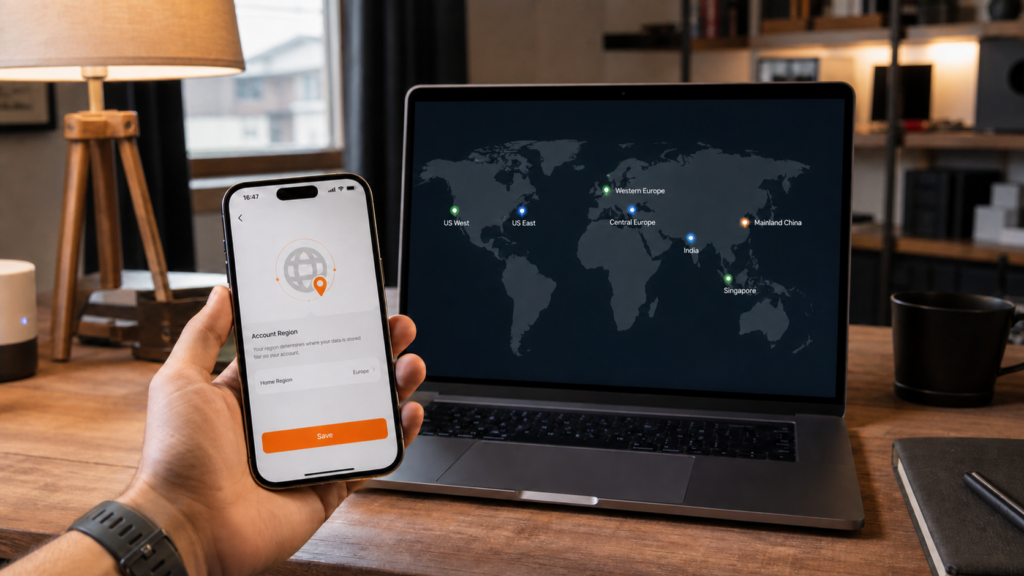
As of Tuya’s most recent trust center update, the company operates seven regional data centers rather than routing everyone through a single China-based server. Per Tuya’s own published breakdown, those centers are mainland China (Tencent Cloud and Alibaba Cloud), Frankfurt and Amsterdam for Europe, Oregon and Virginia for the US, Singapore, and Mumbai for India.
This is Tuya’s own documentation, not something a third party verified independently. That distinction matters for everything else in this article, and I’ll come back to it. But it does mean the “everything goes to China” framing is architecturally inaccurate for accounts registered outside China, at least according to the company describing its own infrastructure.
What determines where your data goes
The data center your account uses is set by the country or region you select when you first register your Tuya or Smart Life account. It has nothing to do with where the device was manufactured, what brand is printed on the box, or which regional Amazon or Shopee listing you bought it from.
That also means the routing isn’t something you can change later. Per Tuya’s own support documentation, a registered account’s region can’t be changed after the fact at all — Tuya states it does not offer a region-modification service, on the grounds that the server where your data is stored can’t be switched arbitrarily. If you registered while traveling, used the wrong region by mistake, or moved countries since, the only way to move your account to a different data center is to delete the account and register a new one in the region you want. There’s no settings toggle for it.
The white-label wrinkle: your no-name plug might be a Tuya device
涂鸦 (Tuya) runs a 白牌 (white-label) business model. It sells the app, cloud backend, and firmware stack to third-party hardware brands, who put their own name on the box. A smart plug or sensor sold under a brand you’ve never heard of, with no mention of Tuya anywhere on the packaging, can still be running entirely on Tuya’s platform underneath.
The practical implication is that brand recognition tells you nothing about which company is actually handling your account data. If the companion app for a device looks a little too polished for a brand you can’t find much about online, or if the app’s account-region selector screen looks familiar from other devices, that’s usually the tell. The Smart Life app itself is Tuya’s own generic client, and plenty of “brand” apps are re-skinned versions of it.
A discrepancy worth stating plainly
Here’s where I ran into something that doesn’t get mentioned in any of the consumer-facing coverage of this topic, and it’s worth being precise about rather than picking whichever source is more convenient.
Tuya’s Chinese trust center page describes Singapore, on Alibaba Cloud, as the dedicated regional data center. But Tuya’s own English-language developer documentation, the region-mapping table maintained on the tuya-home-assistant GitHub wiki, routes most of Southeast Asia and Oceania (Singapore, Malaysia, Indonesia, Philippines, Thailand, Vietnam, Australia, New Zealand, Hong Kong, Taiwan, Japan, and South Korea) to a “Western America” endpoint (openapi.tuyaus.com) by default. That’s a separate, apparently older document from the newer Singapore-specific center the trust center page describes.
I don’t have a way to independently confirm which document reflects the current live routing for an account registered in, say, Singapore or Australia today. It’s entirely possible the GitHub wiki simply hasn’t been updated to reflect the newer regional buildout the trust center page describes. It’s also possible the two systems genuinely coexist for different account types or API integration paths — Tuya maintains a separate developer-facing OEM-app-to-data-center mapping table alongside the consumer trust center page, so more than one routing document is in circulation at once. As of this writing the two haven’t been reconciled into a single consistent statement. I think that kind of internal inconsistency matters more than either document taken alone. If Tuya wants the certifications discussed below to carry weight, its own account-routing documentation should agree with itself.
What Tuya claims about its own security posture
Tuya states that it holds ISO/IEC 27001 and 27701 certifications, has completed SOC 2 Type II and SOC 3 audits, and maintains GDPR and CCPA validation reports. It also states it does not sell customer data to third parties.
These are Tuya’s own claims, published on its own trust center. This site has not independently reviewed the underlying audit reports, and none of the sources for this article did either. Certifications like SOC 2 and ISO 27001 are meaningful in that they require a third-party auditor to sign off on specific controls, so they’re not nothing. But “certified” and “independently verified by us” are different claims, and it’s worth keeping that distinction clear rather than repeating a vendor’s trust-center copy as settled fact.
How to check, and the way to skip the question entirely
If you want to know where your own account’s data lands, the account region you selected at registration is the answer — not the device brand or country of manufacture. Tuya’s support documentation describes that registration region as visible in the app but fixed afterward: the only route to a different data center is deleting the account and re-registering. Treat the region you pick at sign-up as permanent.
The cleaner answer, for readers who’d rather not track any of this, is that the entire question only applies to devices that talk to Tuya’s cloud in the first place. Tuya-based Zigbee devices running through Zigbee2MQTT or ZHA never touch Tuya’s servers during normal operation — they’re paired directly to your own coordinator, so the account-region question simply doesn’t apply to them. That’s a structurally different situation from the Wi-Fi, cloud-first devices this article is about. For Wi-Fi devices where a local-only path doesn’t exist, isolating them on their own network segment limits what they can reach even while the cloud dependency remains; putting Aqara and Xiaomi gear on a dedicated IoT VLAN with Home Assistant walks through that setup, and the same segmentation approach applies just as well to Tuya Wi-Fi devices.
Whether Tuya ever reconciles its two conflicting region-mapping documents is the kind of thing that’s easy to miss unless you’re specifically looking for it. Worth checking back on if you’re making a purchase decision based on data residency rather than just curiosity.