

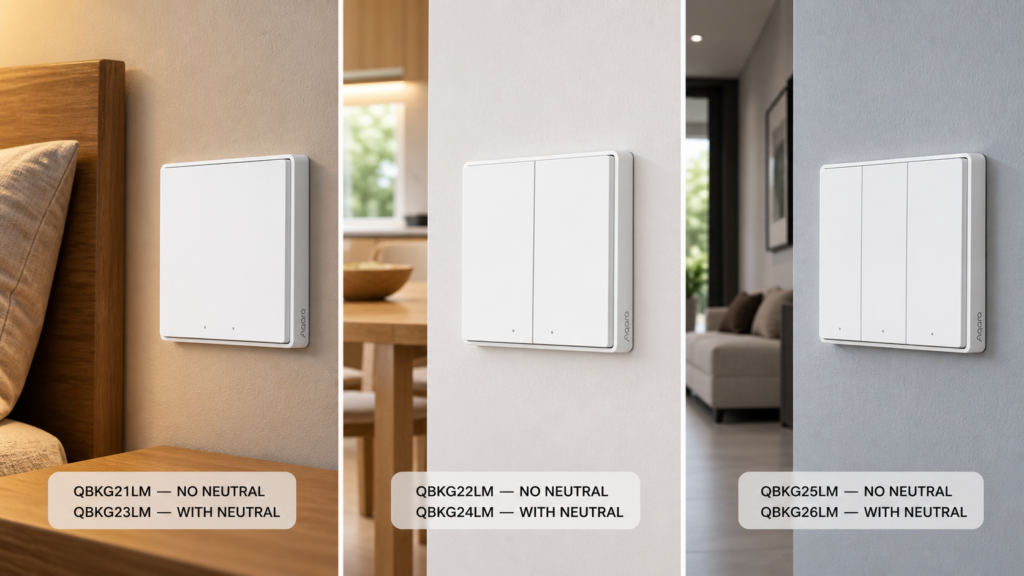
“Aqara D1 switch” isn’t one product. It’s six SKUs spread across three gang sizes. Aqara lists each of them separately, with no cross-model comparison, so if you’re staring at a box, an app listing, or a model number printed on the back plate and trying to work out exactly what you’re holding, this is that lookup.
This site has standalone setup guides for all six — five articles, since the two triple-rocker SKUs share one — and reading them side by side surfaces a pattern none of them states on its own.
Why “Aqara D1 switch” isn’t one product
The D1 name covers single-rocker, double-rocker, and triple-rocker wall switches, and each gang size ships in two electrical variants: one that needs a neutral wire and one that doesn’t. That’s six model numbers:
- QBKG21LM — single-rocker, no neutral
- QBKG22LM — double-rocker, no neutral
- QBKG23LM — single-rocker, with neutral
- QBKG24LM — double-rocker, with neutral
- QBKG25LM — triple-rocker, no neutral
- QBKG26LM — triple-rocker, with neutral
None of these are interchangeable. The neutral requirement is a wiring constraint your electrical box either satisfies or doesn’t, and as the next section covers, it also changes what the device can do on your Zigbee network.
The pattern that identifies your model
The patterns below are this site’s own observation from comparing all five published D1 device pages side by side. Aqara has not documented either convention, and neither is guaranteed to hold for future SKUs.
Within each gang-size pair, the lower model number is the no-neutral variant and operates as a Zigbee end device. The higher model number is the with-neutral variant and operates as a router, with power monitoring the no-neutral sibling lacks entirely. That’s QBKG21LM, QBKG22LM and QBKG25LM (no neutral, end device) against QBKG23LM, QBKG24LM and QBKG26LM (with neutral, router). Note that this is a lower-versus-higher rule inside each pair, not an odd-versus-even rule — QBKG22LM and QBKG24LM are both even numbers on opposite sides of the split.
If the switch is already paired, there’s a more direct check than the SKU number. Every no-neutral D1 carries an l in its Zigbee model ID where its with-neutral sibling carries an n: b1lacn02 against b1nacn02 for the single rocker, b2lacn02 against b2nacn02 for the double, and l3acn3 against n3acn3 for the triple. Zigbee2MQTT and ZHA both surface that ID on the device page, so you can read it off a live device instead of hunting for a label behind a faceplate.
| Model | Gang | Neutral required | Zigbee model ID | Zigbee role | Power monitoring |
|---|---|---|---|---|---|
| QBKG21LM | Single | No | lumi.switch.b1lacn02 | End device | No |
| QBKG22LM | Double | No | lumi.switch.b2lacn02 | End device | No |
| QBKG23LM | Single | Yes | lumi.switch.b1nacn02 | Router | Power, energy, voltage, device temperature |
| QBKG24LM | Double | Yes | lumi.switch.b2nacn02 | Router | Power, energy, voltage, device temperature |
| QBKG25LM | Triple | No | lumi.switch.l3acn3 | End device | No |
| QBKG26LM | Triple | Yes | lumi.switch.n3acn3 | Router | Yes — check your Exposes tab for the exact set |
Why would the neutral wire decide this at all? The likely reading is that a neutral connection gives the switch a continuous power draw instead of relying on the load side to trickle-power it between switch events, and that continuous supply is what a full-time router radio and power-monitoring circuitry both need. Aqara has published no formal explanation of the classification, so treat the mechanism as inference — our QBKG21LM guide flags it the same way. What isn’t in question is the end-device behavior itself, which both the zigpy and Zigbee2MQTT maintainers have confirmed.
For how these codes fit Aqara’s wider naming scheme, see Aqara’s T1/T2/E1/H1/P1 codes explained.
Single-rocker: QBKG21LM vs QBKG23LM
QBKG21LM (lumi.switch.b1lacn02) is the no-neutral single-rocker end device: on/off control, no power monitoring. It has a history of being reported as a router in some integration databases (zigpy issue #3009, Zigbee2MQTT issue #6562) even though it’s an end device by design, and the same applies to its double-rocker sibling. If a mesh map or an old forum thread tells you these relay traffic, that’s the misreport, not your setup.
QBKG23LM (lumi.switch.b1nacn02) is the with-neutral single-rocker router. Same physical footprint, same rocker count, but it exposes power, energy, voltage and device_temperature, and it participates in mesh routing for nearby end devices. It had the opposite problem: early Zigbee2MQTT releases interviewed it as a battery-powered end device, which broke mesh assumptions for anyone relying on it to extend coverage. That one was fixed in Zigbee2MQTT 1.23.0 (issue #10610), which forces the correct device type rather than trusting the interview. The no-neutral misreport above is a different issue in the other direction and isn’t closed by that release — for those models, end device is the correct answer.
Double-rocker: QBKG22LM vs QBKG24LM
QBKG22LM (lumi.switch.b2lacn02) mirrors the single-rocker no-neutral pattern across two channels. Each rocker exposes its own operation_mode, settable to control_left_relay, control_right_relay or decoupled per channel, which is how you separate “physically switches its own relay” from “acts as a button that only fires a Home Assistant automation.” Exact expose names vary by Zigbee2MQTT version, so check the device page for yours.
QBKG24LM (lumi.switch.b2nacn02) adds power monitoring and OTA support on top of that, and its right button uniquely supports the control_right_relay/decoupled combination that lets one rocker control the other relay’s load instead of only its own. That cross-relay control isn’t available on the no-neutral QBKG22LM.
Triple-rocker: QBKG25LM vs QBKG26LM
The triple-rocker pair follows the same no-neutral/end-device against with-neutral/router split as the other two gang sizes. There’s also a physical detail worth checking before you order: both QBKG25LM and QBKG26LM use an 86 x 86 mm square plate, the standard Chinese and Asian wall-box size.
Square 86 mm plates are sold into some European markets, but back-box standards vary by country and several EU box types use different mounting-hole spacing or a 92 mm faceplate. Measure your box and check mounting depth before ordering rather than assuming fitment. Supporting signal, not proof: every D1 model ID ends in the acn segment this site’s WS-EUK01 guide reads as the China-market designation, where Aqara’s EU SKUs use aeu.
The triple-rocker family has a long-running state-reporting problem: the relay toggles and the load responds, but the state change never reaches Zigbee2MQTT, so Home Assistant goes out of sync. It has been reported across multiple coordinators and firmware versions for years (Zigbee2MQTT issues #14673, #17477 and #19719, the last covering decoupled mode specifically), and no fix has been confirmed to resolve it for everyone. Check current issue status before building automations that depend on accurate rocker state.
The most consistent mitigation in those reports is mesh quality — proximity to the coordinator or a router. That lands harder on the QBKG25LM than the QBKG26LM, because the no-neutral model is the end device: it can’t route, so it’s entirely dependent on something else being in range.
Why router vs end device matters for mesh planning
If you’re placing switches with an eye toward mesh coverage, not just wiring convenience, the split matters. A with-neutral D1 switch installed centrally in a hallway relays traffic for nearby battery sensors and can meaningfully help them reach the coordinator. A no-neutral switch in the same spot is a leaf node — it won’t do that job, no matter how close it sits to a struggling sensor.
Where a neutral is already present in the box, specifying the with-neutral model is the better call: you get a mesh router out of a fixture you were installing anyway. That only applies where the wiring is already there. Pulling a new neutral is electrical work, and in most jurisdictions it’s an electrician’s job.
The same identification problem exists one product line over, in the H1 switch lineup. If you haven’t settled on an integration yet, ZHA vs Zigbee2MQTT for Aqara devices covers which one handles this family better.
FAQ
What’s the difference between Aqara QBKG21LM and QBKG23LM?
Both are single-rocker D1 switches. QBKG21LM has no neutral wire requirement, is a Zigbee end device, and has no power monitoring. QBKG23LM requires a neutral wire, is a Zigbee router, and exposes power, energy, voltage and device temperature.
Does the Aqara D1 switch need a neutral wire?
It depends on the SKU. Within each gang-size pair, the lower model number is the no-neutral variant — QBKG21LM, QBKG22LM and QBKG25LM. The higher one requires a neutral: QBKG23LM, QBKG24LM and QBKG26LM. If the device is already paired, check its Zigbee model ID instead: an l in the ID means no neutral, an n means neutral required.
Is the Aqara D1 switch a Zigbee router or end device?
Across all three gang sizes, the no-neutral variant is an end device and the with-neutral variant is a router. The no-neutral models have been misreported as routers in some integration databases, so if your network map disagrees, check zigpy issue #3009 and Zigbee2MQTT issue #6562 before assuming your setup is wrong.
Which Aqara D1 switch has power monitoring?
Only the with-neutral models: QBKG23LM, QBKG24LM and QBKG26LM.
Will an EU wall box fit the Aqara D1 triple switch?
Not reliably. QBKG25LM and QBKG26LM use an 86 x 86 mm square plate — the Chinese and Asian standard. Some European markets do take square 86 mm plates, but back-box standards vary by country and mounting depth is often the real constraint. Measure your box before ordering.
What this verified, and what to check yourself
This piece synthesizes facts already verified and published across five standalone Aqara D1 device articles on this site, each cross-checked against its Zigbee2MQTT device page. No new hands-on testing was performed for this comparison — there’s no test-bench data behind the mesh-routing behavior or the state-reporting bug beyond what those articles and their cited GitHub issues already document. The QBKG25LM and QBKG26LM model IDs were confirmed against Zigbee2MQTT’s device database, since our own triple-rocker guide doesn’t record them.
The link between neutral requirement and Zigbee role is this site’s own synthesis from comparing those device pages directly, not something Aqara publishes. It holds across every SKU in this lineup so far, but treat it as an observation rather than a guarantee for whatever Aqara names next. Before buying or wiring anything, check your own box for a neutral wire and confirm plate size and mounting depth against what’s already installed. And if you’re relying on the triple-rocker’s reported state for automations, check the linked GitHub issues for current status rather than taking this article’s snapshot as final.