

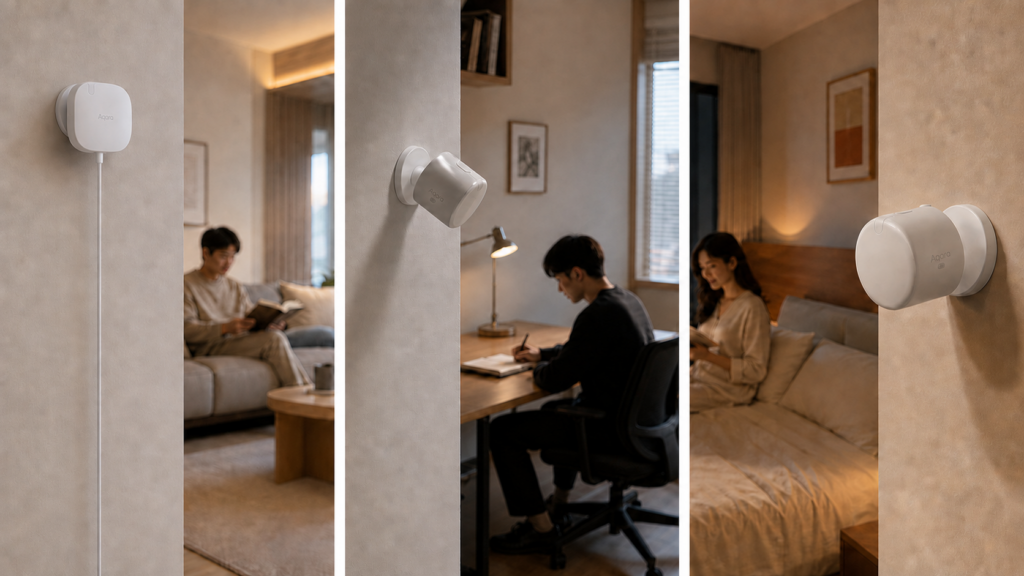
Aqara currently sells three mmWave presence sensors that all turn up in “best presence sensor for Home Assistant” searches, and each takes a genuinely different path into HA. The FP2 speaks HomeKit protocol over Thread and never joins a Zigbee network at all. The FP300 and FP310 both end up in Zigbee2MQTT, but only after a one-time firmware switch through the Aqara app, and they diverge sharply on what happens the next time a firmware update lands. None of that shows up on the product pages, and it matters more than sensing range for anyone planning a Zigbee2MQTT or ZHA setup around one of these.
All three sensors already have their own setup guide on this site, linked below. What’s missing everywhere else, including our own earlier FP2-vs-FP300 piece, is a single place that puts all three side by side and answers the buying question: not which one has the bigger spec sheet number, but which one fits a specific HA setup.
This is a research-synthesis comparison, built from Aqara’s own product pages, the Zigbee2MQTT device pages and issue tracker, and the three individual guides already published here. No new hardware was bought or bench-tested for it. Where that gap matters, mostly around the FP310, it’s called out directly rather than papered over.
Quick verdict
Each sensor has its own setup guide on this site with full pairing steps. This section is the buying decision, not the how-to.
| Model | Radar / sensing | Power | HA integration path |
|---|---|---|---|
| FP2 | 60GHz mmWave, up to 30 zones, multi-person, sleep/fall tracking | Wired, USB-C only | HomeKit Controller integration (not Zigbee) |
| FP300 | 60GHz mmWave + PIR, 5-in-1 (presence, fast-trigger PIR, light, temp, humidity) | Battery, 2x CR2450 | Zigbee2MQTT/ZHA after in-app firmware switch (ships Thread/Matter). No Z2M OTA |
| FP310 | 24GHz mmWave, 4-in-1 (presence, temp, humidity, illuminance) | Battery, 2x CR2450 | Zigbee2MQTT/ZHA after the same in-app firmware switch. Z2M OTA supported |
The FP2 is the only one of the three that does zone-level positioning, multi-person detection, or sleep and fall tracking. The FP300 and FP310 are close siblings — same 6m range, same 120° field of view, near-identical Zigbee feature sets — and the choice between them comes down to 60GHz radar plus a PIR fast-trigger layer and global availability (FP300) against firmware updates you can run from Zigbee2MQTT itself (FP310). Neither arrives ready to join a Zigbee network; both need the same trip through the Aqara app first.
Pricing is deliberately absent from that table: regional listings move often enough that any figure quoted here would be stale within weeks. Check retailer pricing directly.
Aqara FP2: wired mmWave with an Apple-protocol path
The FP2 is the only one of the three built around 60GHz mmWave with real zone positioning, up to 30 zones, plus multi-person detection, sleep tracking, and fall detection. It’s the most capable sensor of the three on paper, and the only one that does any of that zone-level work at all.
The tradeoff is power and protocol. The FP2 is wired, USB-C only, with no battery option, so placement is limited to somewhere near a USB source. And it doesn’t run Zigbee firmware at all — it speaks HomeKit protocol over Thread, so it can’t join Zigbee2MQTT or ZHA the way the other two eventually can.
The FP2 joins Home Assistant through the HomeKit Controller integration, which does not require an Apple ID, the Apple Home app, or an Apple hub. It’s a different integration path from Zigbee2MQTT or ZHA, not a worse one, but it’s worth knowing before assuming every Aqara sensor drops straight into a Zigbee network.
The FP2 also has a documented firmware regression worth knowing about before buying. Firmware 1.3.6 broke interference zone configuration for some users. Our write-up of the 1.3.6 interference zone bug covers what changed and the current workaround. For the full pairing walkthrough, see the FP2 local setup guide.
Aqara FP300: the 60GHz option with a PIR fast-trigger layer
The FP300 is a 5-in-1 sensor combining PIR fast-trigger detection with 60GHz mmWave radar, plus light, temperature, and humidity, across a 120° field of view and 6m max range. It runs on two CR2450 cells, rated around three years in Zigbee mode and about two years in Thread mode.
The catch is that it ships defaulted to Matter/Thread firmware, and that mode exposes only basic occupancy and environmental readings in Home Assistant. To get the full Zigbee2MQTT control surface, the device has to be switched to Zigbee firmware through the Aqara app first. Once switched, it re-identifies in Zigbee2MQTT as model PS-S04D, and roughly 35 additional configuration entities become available, including sensitivity levels, detection range in quarter-metre increments, absence delay, interference identification, AI adaptive mode, and Spatial Learning.
Zigbee2MQTT does not support OTA firmware updates for the FP300. Every update runs through the Aqara app, one device at a time, and the app-side process flashes the sensor to Matter firmware and back to Zigbee again. Community write-ups warn against closing the app mid-update, which can leave the device in an intermediate state needing a factory reset. Factor that in before deploying several across a house.
The firmware step is the part every spec sheet skips, and it’s the single biggest difference between “FP300 on paper” and “FP300 actually running in Home Assistant.” The full conversion and pairing steps are in our FP300 Zigbee2MQTT guide.
Aqara FP310: the 24GHz variant, honest tradeoffs
The FP310 is a 4-in-1 sensor — presence, temperature, humidity, and illuminance — over the same 120° field of view and 6m range as the FP300, but without the FP300’s dedicated PIR fast-trigger layer. It’s battery powered, and Zigbee2MQTT supports it natively, identifying it as lumi.sensor_occupy.acn1.
“Native Zigbee2MQTT support” is the phrase most likely to be misread here, and it’s worth being precise about. It means Z2M ships a built-in device definition for the FP310, so no external converter is needed. It does not mean the sensor arrives running Zigbee firmware. The FP310 is a Matter-registered Thread device like the FP300, and our own FP310 setup guide documents the same one-time Aqara-app cross-flash from Thread to Zigbee before Z2M can see it at all. Anyone buying an FP310 specifically to skip the app step should plan on doing it anyway.
What the FP310 buys over the FP300 is what happens afterwards. Its Z2M support includes OTA, so firmware updates run from the OTA tab in the Z2M web UI. The FP300 has no Z2M OTA path, and each of its updates is another round trip through the Aqara app. Across several sensors and several years of firmware, that’s the difference that compounds.
The 24GHz radar, instead of the FP300’s 60GHz, comes down to regional radio rules. Aqara’s own positioning is that 60GHz indoor unlicensed use isn’t clearly permitted in certain markets, China being the relevant one here. Independent coverage of the launch describes that substitution as carrying a real accuracy cost, since 24GHz is generally less precise for advanced zone detection and for picking up micro-movement or breathing-level detection. It’s a deliberate regulatory tradeoff rather than a downgrade for its own sake, but the FP310 isn’t simply a cheaper FP300.
There’s also a Zigbee2MQTT issue worth knowing about before relying on this sensor for anything critical. Issue #32189, opened 3 June 2026, reports FP310 units becoming unresponsive under native Z2M support, with the reporter correlating it to the detection_range attribute (0x019a): presence state got stuck when that attribute was read or written, and dropping it made the device noticeably more stable. The issue is now closed. Closed isn’t the same as fixed, and the thread doesn’t spell out a confirmed resolution, so anyone deploying an FP310 should check the current state of that thread and their own Z2M changelog rather than assume the behaviour is gone.
The FP310 currently reads as primarily available through China-oriented listings based on the vendor and retailer pages checked for this piece. Readers outside China shopping for one should confirm it’s actually sellable to their region before planning around it, rather than assuming the same universal retail availability as the FP2 or FP300.
Zigbee2MQTT and Home Assistant compatibility, side by side
| Model | Firmware as shipped | Z2M/ZHA entities | Firmware updates |
|---|---|---|---|
| FP2 | HomeKit protocol (Thread) | Not applicable, joins via HomeKit Controller instead | Aqara app / HomeKit; zone and multi-person data exposed through the HomeKit accessory |
| FP300 | Matter/Thread by default | Basic occupancy + environmental until switched to Zigbee; ~35 extra config entities after | Aqara app only, one device at a time. No Z2M OTA |
| FP310 | Matter/Thread by default | Native Z2M definition (lumi.sensor_occupy.acn1) after the same app-side switch | Z2M OTA supported. One closed issue (#32189) reporting unresponsiveness tied to detection_range |
So “works with Home Assistant” means three different things here. The FP2’s path is a non-Zigbee integration that’s still fully local. The FP300 and FP310 both work through Zigbee2MQTT or ZHA, but only after a vendor-app firmware switch that neither product page leads with — and only the FP310 lets you handle updates locally afterwards.
Which one to buy
For anyone who needs zone-level positioning, multi-person tracking, or sleep and fall detection, the FP2 is the only option — none of that exists on the FP300 or FP310 — and wired-only placement plus a HomeKit-protocol integration are the price of it.
For anyone who wants battery power with the more capable radar, the FP300 is the stronger pick. Its 60GHz radar plus a dedicated PIR fast-trigger layer means faster initial detection and better micro-movement sensitivity than the FP310. The cost is that every firmware update means another session with the Aqara app.
For anyone who wants to keep firmware maintenance inside the local stack, the FP310 is the one that manages it, since Z2M can push its OTA updates directly. Honestly, though, the availability gap matters more here than either the 24GHz-versus-60GHz accuracy tradeoff or the OTA convenience. A sensor that’s hard to source outside China isn’t a real option for a lot of readers, however it performs on paper, and that’s a more practical filter than the radar spec.
FAQ
What’s the difference between Aqara FP2 and FP300?
The FP2 is wired, uses 60GHz mmWave with zone positioning and multi-person detection, and joins Home Assistant through HomeKit Controller rather than Zigbee. The FP300 is battery powered, combines PIR with 60GHz radar, and needs a firmware switch through the Aqara app before it exposes its full Zigbee2MQTT entity set.
Does the Aqara FP310 need the same firmware switch as the FP300?
Yes. Zigbee2MQTT having native support for the FP310 means Z2M ships a built-in device definition for it, not that the sensor arrives running Zigbee. Like the FP300, it ships as a Thread/Matter device and needs a one-time cross-flash through the Aqara app before it can pair with Z2M.
Is the Aqara FP310 available outside China?
Based on the listings checked for this piece, availability currently skews toward China-oriented retailers. Confirm it’s actually sellable to your region before planning a purchase around it.
Does the Aqara FP300 work with Zigbee2MQTT out of the box?
Not fully. It ships on Matter/Thread firmware, which exposes only basic occupancy and environmental data in Home Assistant. The deeper Zigbee2MQTT entity set requires switching the firmware to Zigbee through the Aqara app first.
Which Aqara presence sensor is best for Home Assistant?
It depends on the setup. The FP2 wins on sensing capability if wired placement and a non-Zigbee integration path are acceptable. The FP300 wins on radar capability and global availability. The FP310 wins on local firmware maintenance, since Z2M can OTA-update it, if it’s actually available to buy in the reader’s region.
Can the Aqara FP2 be added to Zigbee2MQTT?
No. The FP2 doesn’t run Zigbee firmware. It speaks HomeKit protocol over Thread and joins Home Assistant through the HomeKit Controller integration instead.
What this comparison verified
This piece was built from Aqara’s own product and blog pages, the Zigbee2MQTT device database and issue tracker, and the three individual device guides already published on this site for the FP2, FP300, and FP310. Nothing here reflects new hands-on testing, and no bench data was generated for this comparison specifically.
Two claims were checked at the source rather than carried over from spec-sheet summaries. Zigbee2MQTT issue #32189 is closed, not open, and the date attached to it is when it was reported rather than evidence of anything since. And “native Zigbee2MQTT support” for the FP310 describes Z2M’s built-in device definition, not the firmware the sensor ships with. What we could not confirm from a primary Aqara specification is whether any FP310 retail batch ships in Zigbee mode already; the Matter registry listing and our own setup guide both point to Thread/Matter as the default.
All three integration paths stay local once running. The vendor app is still in the loop at two points: the initial Thread-to-Zigbee switch on both battery sensors, and every subsequent FP300 firmware update, since Z2M doesn’t handle OTA for that model.
Before buying: confirm which firmware mode an FP300 or FP310 listing ships with, confirm FP310 availability to your actual shipping region, and if you’re deploying FP310s at any scale, read issue #32189 in its current state rather than assuming closed means fixed.
This piece supersedes our earlier two-way FP2 vs FP300 comparison for buying decisions going forward. That piece is still accurate for what it covers, it just predates the FP310 and no longer answers the full question.